How does programmatic advertising work
 If you have ever looked up a pair of shoes and then, somehow, those exact shoes follow you around the internet for the next week, that is not magic. It is not even a super smart human sitting behind a screen picking ads for you in real time.
It is programmatic advertising, a term that might sound like one of those marketing buzzwords people throw into slide decks. But once you see how it actually works, it is surprisingly logical. A little messy. Sometimes creepy. But logical.
Let’s break it down without turning it into a textbook.
What “programmatic advertising” actually means
Programmatic advertising is the automated buying and selling of digital ad space. Instead of a person emailing a publisher like: “Hey, can I buy a banner on your homepage next Tuesday?” A machine does it. Instantly. Based on rules. Data. And bids.
So programmatic is not a specific ad format. It is a way to buy ads. You can run programmatic display ads, video ads, native ads, audio ads, even connected TV. The common thread is that software is deciding, in real time, which ad gets shown to which person, and how much that impression is worth.
The basic idea in one line
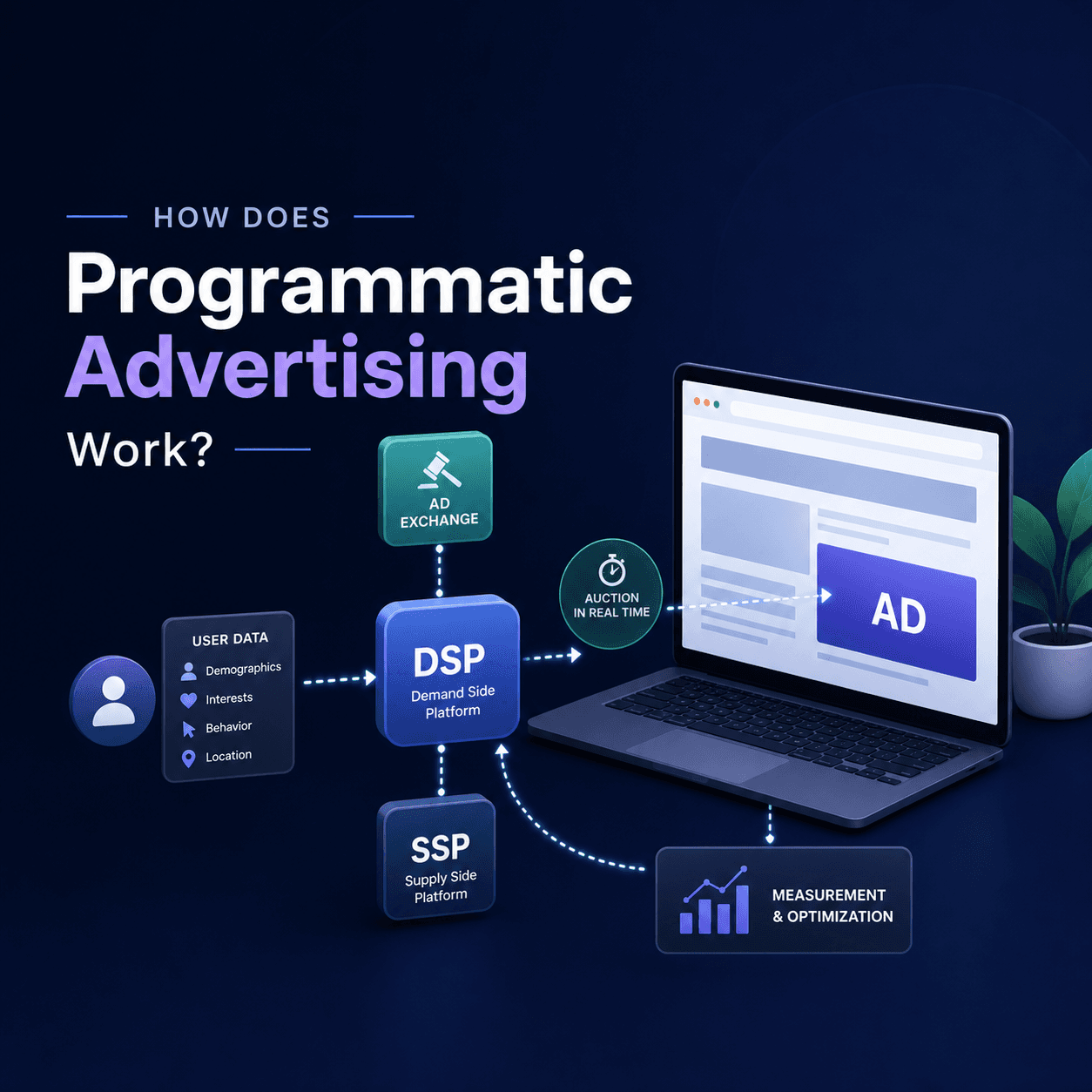
When a webpage (or app) loads, an auction happens in the background in milliseconds, and the winning advertiser gets to show their ad. That auction process is the heart of programmatic. People call it real time bidding, or RTB. RTB is not the only type of programmatic buying, but it is the most talked about one because it is fast and it is everywhere.
The main players (you will hear these terms a lot)
Before we do the step by step, you need to know who is involved.
1. Advertiser
This is the brand or business that wants attention. It could be Nike, your local online course creator, or Nevolearn if they are promoting something.
2. Publisher
The website or app that has ad space to sell. This could be news sites, blogs, mobile games, streaming platforms, etc.
3. DSP (Demand Side Platform)
This is the tool advertisers use to buy ads programmatically. Think of it like an automated media buying cockpit.
You set targeting, budget, creatives, bidding strategy, and the DSP does the rest.
Examples include Google Display and Video 360, The Trade Desk, Amazon DSP, etc.
4. SSP (Supply Side Platform)
This is the tool publishers use to sell their ad space programmatically. It helps them manage inventory, set minimum prices, and connect to multiple buyers. Examples include Google Ad Manager, Magnite, PubMatic, OpenX, etc.
5. Ad Exchange
This is where the buying and selling connects - the marketplace. Exchanges facilitate auctions between DSPs and SSPs.
Sometimes the SSP includes exchange functionality; sometimes it is separate. People use the term loosely, but the role is basically: run the auction and route bids.
6. Data providers (optional but common)
These help with audience targeting and enrichment. Sometimes it is first party data (your own customer list). Other times it could be third party data (less common now due to privacy changes).
7. The user
That is you. The person loading the site. The person being matched with an ad.
Ok, now we can actually talk about the flow.
Step by step: what happens when a page loads
Let’s say you open a website that has programmatic ads.
Here is what happens, in a simplified sequence.
Step 1: The webpage requests an ad
As the page loads, the publisher’s site says:
“I have an ad slot here. I need an ad.”
This request goes to the publisher’s ad server, usually through their SSP setup.
Step 2: Information about the impression is packaged
The system gathers what it knows about that ad opportunity, like:
- The size of the ad slot (banner, video, etc.)
- The page category or content context (sports, finance, tech)
- Approximate location (city level, sometimes more, depending on consent)
- Device type (mobile, desktop, tablet)
- Browser
- Anonymous identifiers (cookies or mobile ad IDs, again depending on privacy and consent)
- Any first party audience segments the publisher has
Important detail: ideally, this is not supposed to include personally identifiable information. But it can still feel personal because of how accurate targeting can get.
Step 3: The SSP sends bid requests to multiple DSPs
The SSP says to the market:
“Who wants to buy this impression?”
It sends a bid request to many DSPs. Each DSP represents lots of advertisers.
Step 4: DSPs decide if the impression is worth bidding on
Inside each DSP, a bunch of decisions happen fast:
- Does this user match the advertiser’s targeting?
- Is the context right?
- Is the user in a retargeting list?
- Is the impression likely to convert?
- Is the bid price within budget rules?
- Is there frequency control? (like do not show this ad more than 3 times per day)
- Is the placement brand safe? (no ads next to sketchy content)
Then the DSP submits a bid. Or it passes.
Step 5: The auction runs and a winner is picked
The ad exchange or SSP compares bids and chooses a winner.
Auctions can be first price or second price, but first price is more common now.
- First price: highest bidder pays what they bid.
- Second price: highest bidder wins but pays a bit more than the second highest bid.
This matters because bidding strategies change based on auction type, but for understanding the workflow, just think: highest qualified bid wins.
Step 6: The winning ad loads on the page
The publisher serves the ad creative from the advertiser, and you see it.
All of this can happen in around 100 to 300 milliseconds. Sometimes faster, sometimes slower.
That is why programmatic is powerful. It is not just automated. It is real time.
So where does targeting come from
This is usually the part people are most curious about.
Programmatic targeting can come from a few directions:
Contextual targeting
This is the simplest and it is making a comeback because of privacy changes.
The ad is targeted based on the content of the page, not the person.
Example: You are reading an article about running shoes, so you see an ad for running socks.
Audience targeting (cookie based or ID based)
This uses identifiers to recognize a browser or device and match it to interest segments.
Example segments:
- “Frequent travelers”
- “Auto intenders”
- “Luxury shoppers”
- “Recently visited competitor website”
- “Cart abandoners”
This is the classic “I looked at shoes and now I see shoes everywhere” thing.
First party data targeting
This is data a business collects directly, like email lists, customer IDs, purchase history, CRM data.
Advertisers can upload hashed email lists, create lookalike audiences, or suppress existing customers from seeing acquisition ads.
In 2026, first party data is basically the currency. Everyone wants it because third party data is weaker and more restricted now.
Geo targeting
Target by country, region, city, or sometimes radius targeting around a location, depending on platform and consent.
Device targeting
Mobile vs desktop, operating system, connected TV, app vs web, etc.
Frequency and recency
Not exactly targeting, but it controls exposure.
- Frequency cap: do not show too many times
- Recency: only show again after X hours/days
This is how advertisers try not to annoy people too much. Try.
Different types of programmatic deals (not all are auctions)
RTB open auctions are the default mental model, but programmatic has other buying methods too.
Open auction
Anyone can bid. This has the most scale, but also the most variability in quality.
Private marketplace (PMP)
Invite only auction. A publisher offers premium inventory to selected advertisers or DSPs.
Better control, often better placements, often higher minimum prices.
Preferred deal
A buyer gets first look at inventory at a negotiated price. Not guaranteed, but priority access.
Programmatic guaranteed
This is closest to traditional media buying, but automated.
The buyer and seller agree on price and volume ahead of time, and delivery is guaranteed. Still uses programmatic pipes for serving and reporting.
If you are a brand that cares a lot about where your ads show up, you tend to move toward PMPs and guaranteed deals.
Why programmatic advertising exists (the honest reason)
Because manual ad buying does not scale.
Imagine trying to negotiate ad placements across 5,000 websites manually. Even if you had a big team, it would be slow, expensive, and you would still miss tons of opportunities.
Programmatic lets advertisers:
- Buy impressions one by one based on value
- Optimize campaigns continuously
- Reach niche audiences at scale
- Measure performance more precisely
- Adjust creative and bidding in real time
And for publishers, it helps them:
- Fill inventory efficiently
- Increase competition for impressions
- Improve yield (earn more per ad slot)
- Access global demand
It is basically automation for a market that moves too fast for humans.
What happens after the ad is shown (tracking and measurement)
After an impression is served, a few things can be tracked:
- Impression: ad was displayed
- Click: user clicked
- View through conversion: user saw the ad, did not click, but converted later
- Conversions: purchase, lead form, signup, etc.
- Video metrics: starts, quartiles, completions
- Engagement: time on site, pages viewed (depends on setup)
This measurement data flows back into the DSP, which then updates bidding decisions.
So the system learns. Not like a human learns, but statistically. More like:
“These placements convert better. Bid more there.” “These users never convert. Stop bidding.”
Where it can go wrong (and why people complain about programmatic)
Programmatic is not automatically “good” marketing. It is just an efficient buying system. Problems still happen.
Ad fraud
Bots generate fake impressions and fake clicks. Entire fake websites can exist just to farm ad money.
Good DSPs and verification tools fight this, but it is a constant game.
Brand safety issues
Ads can show next to content you do not want to be associated with. This is why advertisers use blocklists, allowlists, and verification.
Too much retargeting
You looked at one product, now it haunts you for 14 days. That is lazy retargeting setup. Bad frequency caps. Bad suppression lists.
Data privacy and consent complexity
Between GDPR, CCPA, and all the cookie and ID changes, the data side is harder than it used to be.
Which is why contextual targeting and first party data strategies are rising again.
A quick example (so it feels real)
Let’s say Nevolearn is promoting a course.
They set up a campaign in a DSP:
- Target: people interested in upskilling, online learning, maybe specific job roles
- Placements: education blogs, productivity content, YouTube type inventory if video
- Budget: say $100 per day
- Goal: signups
A user visits a blog about career switching.
The publisher sends a bid request. The DSP checks if the user matches Nevolearn’s targeting, checks predicted conversion likelihood, then bids maybe $1.80 CPM equivalent for that impression (could be more or less).
Other advertisers bid too. Nevolearn wins. Their ad shows. The user signs up later that evening.
That conversion gets reported back, and the DSP becomes more confident in similar impressions.
That is programmatic in motion.
The simplest way to remember it
If you forget everything else, keep this mental model:
- Publishers have ad space.
- Advertisers want attention.
- DSPs buy. SSPs sell.
- An auction happens in milliseconds.
- Data helps decide who bids and how much.
- Results feed back into bidding and optimization.
That is it.
Wrap up
Programmatic advertising works because it turns ad buying into a real time marketplace.
It is fast, automated, and scalable. It can also be wasteful if you do not control targeting, placements, frequency, and measurement properly.
If you are an advertiser, the win is precision and efficiency. If you are a publisher, the win is filling inventory and increasing competition. If you are a user, well. You get relevance sometimes. And sometimes you get chased around by the same ad for days. Depends how well it is set up.
If you want to learn this stuff properly, not just the vocabulary but the practical side of it, enroll with Nevolearn.
FAQs (Frequently Asked Questions)
What is programmatic advertising and how does it work?
Programmatic advertising is the automated buying and selling of digital ad space using software that decides in real time which ads to show to which users based on data, rules, and bids. Instead of manual negotiations, machines conduct auctions within milliseconds when a webpage or app loads, enabling advertisers to target audiences efficiently across various ad formats like display, video, native, audio, and connected TV.
Who are the main players involved in programmatic advertising?
The key participants in programmatic advertising include Advertisers (brands or businesses seeking attention), Publishers (websites or apps selling ad space), Demand Side Platforms (DSPs) used by advertisers to buy ads programmatically, Supply Side Platforms (SSPs) used by publishers to sell their inventory, Ad Exchanges that facilitate auctions between DSPs and SSPs, Data Providers who assist with audience targeting, and the Users who view the ads.
What happens during a real-time bidding (RTB) auction in programmatic advertising?
When a user loads a webpage with ad space, the publisher's SSP sends bid requests containing information about the impression to multiple DSPs. Each DSP evaluates if the user matches advertiser targeting criteria and submits bids accordingly. The ad exchange or SSP then runs an auction—usually first price—selects the highest qualified bid as the winner, and serves that advertiser's creative on the page within 100 to 300 milliseconds.
How is user information handled during programmatic ad auctions?
Information packaged for each ad impression includes details like ad slot size, page category, approximate location (city level), device type, browser type, anonymous identifiers such as cookies or mobile ad IDs (subject to privacy consents), and any first-party audience segments from publishers. Although personally identifiable information is ideally excluded, precise targeting can still feel personal due to data enrichment.
What types of ads can be bought using programmatic advertising?
Programmatic advertising is not limited to one format; it enables buying various digital ad types including display banners, video ads, native ads integrated into content feeds, audio ads on streaming platforms, and connected TV commercials. The commonality is that all these ads are purchased automatically through real-time auctions powered by software platforms.
Why is programmatic advertising considered powerful and efficient?
Programmatic advertising is powerful because it automates media buying in real time—auctions happen within milliseconds—allowing advertisers to precisely target audiences based on data while optimizing budgets. This automation reduces manual processes, improves efficiency across multiple channels and devices, ensures brand safety controls, frequency caps, and dynamic bidding strategies that adapt instantly to market conditions.