
Project management has evolved significantly over the last decade. Organizations today don't just look for professionals who can complete projects on time, they seek leaders who can manage changing priorities, lead distributed teams, embrace Agile practices, and deliver measurable business outcomes.
As industries continue their digital transformation journey, project management certifications have become an important differentiator for professionals looking to advance their careers. Among the many certifications available, PMP®, PRINCE2®, and PMI-ACP® consistently stand out as the most recognized credentials worldwide.
But choosing the right certification isn't always straightforward.
Should you pursue PMP because it is globally recognized? Is PRINCE2 better for structured project environments? Or does PMI-ACP offer greater value as Agile adoption continues to accelerate?
This guide compares all three certifications based on eligibility, exam structure, industry recognition, career opportunities, salary potential, and future relevance to help you make an informed decision.
If you're new to project management, you may also find NevoLearn's Project Management courses helpful before choosing a certification path.
Why Project Management Certifications Matter More Than Ever
Modern businesses operate in environments where customer expectations change rapidly, technology evolves continuously, and projects become increasingly complex.
Certified project managers often demonstrate:
Better project planning capabilities
Strong leadership skills
Risk management expertise
Improved stakeholder communication
Greater understanding of project governance
Ability to deliver projects successfully
Many multinational organizations also prefer certified professionals because certification validates globally accepted project management practices.
Whether you work in IT, manufacturing, healthcare, finance, telecom, construction, or consulting, a recognized certification can significantly improve your career prospects.
Understanding PMP Certification
The Project Management Professional (PMP) certification is offered by the Project Management Institute (PMI) and is widely regarded as one of the most prestigious project management certifications globally.
Rather than focusing on one specific methodology, PMP covers multiple project management approaches, including:
Predictive (Waterfall)
Agile
Hybrid project management
This makes PMP suitable for professionals working across different industries and project environments.
Who Should Choose PMP?
PMP is ideal for:
Experienced Project Managers
Senior Project Coordinators
Program Managers
Delivery Managers
Technical Project Managers
IT Project Leads
Engineering Managers
Professionals who already have project management experience generally benefit the most from PMP certification.
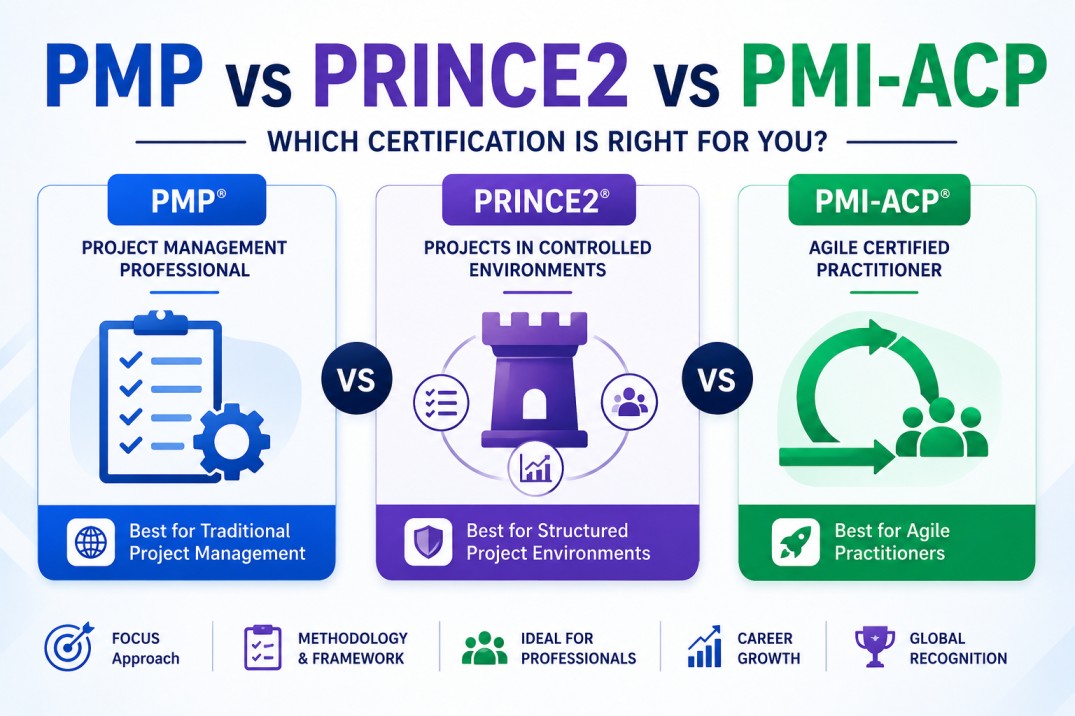
PRINCE2 (Projects IN Controlled Environments) originated in the UK and has become one of the world's most structured project management frameworks. Unlike PMP, which focuses heavily on competencies and knowledge areas, PRINCE2 emphasizes: Defined processes Project governance Roles and responsibilities Documentation Controlled project stages Business justification PRINCE2 is especially popular within government organizations, public sector projects, and enterprises following standardized project delivery models. PRINCE2 is suitable for: Project Coordinators PMO Professionals Government Project Managers Business Consultants Delivery Managers Professionals working in Europe and Commonwealth countries Organizations looking for standardized project governance often prefer PRINCE2-certified professionals. As Agile methodologies become the preferred approach for software development and digital transformation initiatives, PMI introduced the Agile Certified Practitioner (PMI-ACP) certification. Unlike certifications that focus on a single Agile framework, PMI-ACP covers multiple Agile methodologies, including: Scrum Kanban Lean XP (Extreme Programming) Crystal Feature-Driven Development The certification validates your ability to work effectively in Agile environments while managing projects collaboratively. PMI-ACP is an excellent choice for: Scrum Masters Agile Coaches Product Owners Agile Project Managers Delivery Managers Software Development Professionals DevOps Professionals Transformation Consultants As Agile adoption continues across industries, PMI-ACP has become increasingly valuable for technology professionals. Each certification addresses a different aspect of project management rather than directly competing with one another. Candidates generally require: Project management experience Project management education or training Secondary or bachelor's degree (requirements vary depending on education level) PMP is designed for professionals who have already managed projects. One of PRINCE2's biggest advantages is accessibility. For PRINCE2 Foundation: No prior experience required For Practitioner level: Foundation certification or an equivalent prerequisite This makes PRINCE2 beginner-friendly. PMI-ACP expects candidates to have: Agile project experience Agile training Experience working in Agile teams It is ideal for professionals already involved in Scrum or Agile delivery environments. Each certification presents different challenges. The PMP examination evaluates: Scenario-based decision making Leadership Risk management Business environment Hybrid project management Stakeholder management Questions are highly situational rather than theoretical. PRINCE2 exams focus more on: Processes Themes Principles Governance Documentation Candidates need a strong understanding of the framework. PMI-ACP emphasizes practical Agile implementation. Questions often assess: Scrum practices Kanban Agile leadership Team collaboration Value delivery Continuous improvement Practical Agile experience significantly improves success rates. PMP is highly valued across: Information Technology Banking Healthcare Manufacturing Construction Telecommunications Energy Consulting PRINCE2 is common in: Government organizations Public sector Infrastructure projects European enterprises Financial services PMI-ACP is particularly valuable in: Software development SaaS companies Product-based organizations Startups Digital transformation consulting Cloud engineering DevOps teams The right certification often depends on where you are in your professional journey. Early Career Professionals: PRINCE2 Foundation provides a structured introduction to project management concepts and is suitable for those with limited experience. Experienced Project Managers: PMP offers comprehensive recognition and is widely preferred for leadership roles across industries. Agile Professionals: PMI-ACP is ideal for individuals already working in Agile environments who want to deepen their expertise and validate their skills. Many professionals eventually earn more than one certification as their careers evolve. For example, a project manager may start with PRINCE2 Foundation, progress to PMP after gaining experience, and later pursue PMI-ACP as Agile methodologies become central to their organization. While salaries vary depending on location, industry, experience, and organization size, professionals with globally recognized project management certifications often enjoy better earning potential than their non-certified peers. Below is a general comparison based on current hiring trends across India and international markets. These salary ranges represent experienced professionals. Factors such as leadership experience, domain expertise, and the complexity of projects managed often influence compensation more than certification alone. However, certifications strengthen your profile and can improve opportunities for career advancement. The project management profession continues to expand across industries as organizations invest in digital transformation, cloud migration, AI adoption, and business modernization. Let's look at where each certification stands today. PMP remains one of the most sought-after certifications for professionals managing large-scale and cross-functional projects. Employers hiring for roles such as Project Manager, Senior Project Manager, Program Manager, Delivery Manager, and PMO Lead frequently list PMP as a preferred or mandatory qualification. Its broad applicability across industries makes it valuable for professionals seeking leadership positions. PRINCE2 continues to be highly regarded in organizations that emphasize governance, standardized processes, and controlled project execution. It is particularly valuable in: Government agencies Public sector organizations Infrastructure and construction projects Financial services European and Commonwealth markets Professionals working in these sectors often find PRINCE2 to be a strong addition to their credentials. Agile practices are no longer limited to software development. Today, industries such as banking, healthcare, manufacturing, and retail are embracing Agile principles to improve adaptability and customer value. As a result, PMI-ACP has gained significant traction among organizations looking for professionals who can lead Agile teams, facilitate collaboration, and deliver iterative improvements. Roles such as Agile Project Manager, Scrum Master, Product Owner, and Agile Coach increasingly recognize PMI-ACP as a valuable certification. When evaluating certifications, consider not only the exam cost but also the long-term value they bring to your career. Experienced professionals aiming for leadership roles Individuals seeking global recognition Those managing complex, cross-functional projects Strong brand recognition High demand across industries Excellent long-term career growth Beginners entering project management Professionals in process-driven organizations Those working in governance-focused environments Easy entry point Practical project framework Widely recognized in Europe and government sectors Agile practitioners Software professionals Product teams Digital transformation specialists High relevance in Agile-driven organizations Strong alignment with modern delivery practices Growing demand across industries Rather than asking which certification is "better," consider which one aligns with your current role and future aspirations. Lead enterprise-scale projects Transition into Program or Portfolio Management Manage projects across multiple methodologies Work with multinational organizations Strengthen your leadership profile If your goal is to become a senior project leader, NevoLearn's PMP Certification Training provides structured preparation aligned with the latest exam objectives. Learn a structured project management framework Work in governance-heavy environments Build foundational project management skills Pursue opportunities in Europe or the public sector PRINCE2 is also a practical starting point for professionals planning to earn additional certifications later. Build a career in Agile project management Work as a Scrum Master or Agile Coach Lead Agile software development teams Support digital transformation initiatives If you are already familiar with Scrum or Kanban, PMI-ACP can help validate your Agile expertise and open doors to advanced roles. Absolutely. Many experienced professionals combine certifications to broaden their expertise. Common certification paths include: PRINCE2 Foundation → PMP for professionals moving from structured project environments to broader leadership roles. PMP → PMI-ACP for project managers expanding into Agile delivery. PRINCE2 → PMI-ACP for those transitioning from governance-focused roles to Agile transformation initiatives. Having multiple certifications demonstrates versatility and a commitment to continuous learning, especially in organizations that use both traditional and Agile approaches. Selecting a certification solely based on popularity can lead to unnecessary challenges. Keep these points in mind: Don't choose PMP without the required project management experience. It is designed for professionals who have already managed projects. Avoid assuming PRINCE2 is only for the UK. While it originated there, it is recognized globally in many industries. Don't pursue PMI-ACP if you have no exposure to Agile practices. Practical experience with Agile teams makes the certification far more valuable. Focus on your career goals rather than salary alone. The right certification should align with the type of projects and roles you want in the future. The project management landscape is evolving with technologies such as Artificial Intelligence, automation, predictive analytics, and hybrid work models. However, the need for skilled project leaders remains strong. Looking ahead: PMP is expected to remain the preferred certification for senior project and program management roles. PRINCE2 will continue to be relevant in governance-driven and regulated industries. PMI-ACP is likely to grow in demand as Agile and hybrid delivery models become the standard across more sectors. Rather than replacing one another, these certifications complement different career paths and project environments. There is no universal "best" certification, only the one that best fits your experience and career goals. Choose PMP if you are an experienced project manager seeking global recognition and leadership opportunities. Choose PRINCE2 if you want a structured project management framework or are beginning your project management journey. Choose PMI-ACP if you work in Agile environments and want to specialize in modern project delivery practices. As organizations increasingly adopt hybrid methodologies that combine traditional project management with Agile practices, professionals who continue to upskill will remain highly competitive. If you're planning to advance your career, explore NevoLearn's Project Management Certification Programs to find training aligned with your goals. Whether you're preparing for PMP, PMI-ACP, or other project management certifications, structured learning and hands-on guidance can significantly improve your chances of success.Understanding PRINCE2 Certification
Who Should Choose PRINCE2?
Understanding PMI-ACP Certification
Who Should Choose PMI-ACP?
PMP vs PRINCE2 vs PMI-ACP: Feature Comparison
Eligibility Requirements
PMP Eligibility
PRINCE2 Eligibility
PMI-ACP Eligibility
Exam Difficulty Comparison
PMP
PRINCE2
PMI-ACP
Which Industries Prefer Each Certification?
PMP
PRINCE2
PMI-ACP
Choosing Based on Your Career Stage
Salary Comparison: PMP vs PRINCE2 vs PMI-ACP
Global Demand for Each Certification
PMP: The Global Benchmark
PRINCE2: Strong in Structured Environments
PMI-ACP: Rising with Agile Adoption
Which Certification Offers the Best Return on Investment?
PMP
Best for:
Why it stands out:
PRINCE2
Best for:
Why it stands out:
PMI-ACP
Best for:
Why it stands out:
Choosing the Right Certification Based on Your Career Goals
Choose PMP If You Want To:
Choose PRINCE2 If You Want To:
Choose PMI-ACP If You Want To:
Can You Earn More Than One Certification?
Common Mistakes to Avoid When Choosing a Certification
Which Certification Will Stay Relevant?
Final Verdict